
Statement
My practice is built on contrast. I work across multiple mediums, pressing rough against smooth, dense against fragile, organic against industrial — because adjacency sharpens difference. A coarse surface reads as coarser when it meets a polished one; a soft form feels softer beside something brutal.
This is not a formal exercise. We live in an increasingly polarised world, and I believe material contrast is one of the most direct ways to make that condition visible. By combining mediums that resist each other, I create surfaces and structures that hold tension rather than resolve it — work that refuses the smoothness of a single narrative.
The texture is the argument. The friction is the point.
Bio
I'm self-taught. No formal training, no institutional validation — just an eye I've always had and the stubborn refusal to ignore it. The permission to call myself an artist took years to arrive.
I was born and raised in Crawley — a post-war satellite town wedged between London and Brighton, built for function, not inspiration. But constraint has a way of shaping you. I spent my early twenties as a freelance photographer, watching the ceiling get lower. I knew that if I was going to push, I needed to leave.
London came next. I landed in Whitechapel in 2018, living in a former Salvation Army hostel under property guardianship — cheap, vast, and full of room to experiment. I moved through photography, furniture, painting, and more, always feeling the pressure to pick one and commit. It took a pandemic and a period of forced stillness to see what had been true all along: the different practices weren't distractions. They were mediums on the same palette. I was an artist. The journey began.
My Work
My work draws from the world around us — politically, physically, materially. The world is becoming increasingly polarised, and I try to hold that tension: combining materials that shouldn't coexist, creating surfaces that are beautiful and uncomfortable in equal measure. The prettiest things carry the darkest messages. Caravaggio understood that. So does this work.
I started with ink and charcoal, drawn to the depth and texture two simple mediums could produce. Then came paint and resin. Then the moment I noticed people battling with themselves over whether or not to reach out and touch one of my paintings — and I knew the work needed to become three-dimensional. Objects you could actually pick up. Forms that demanded contact.
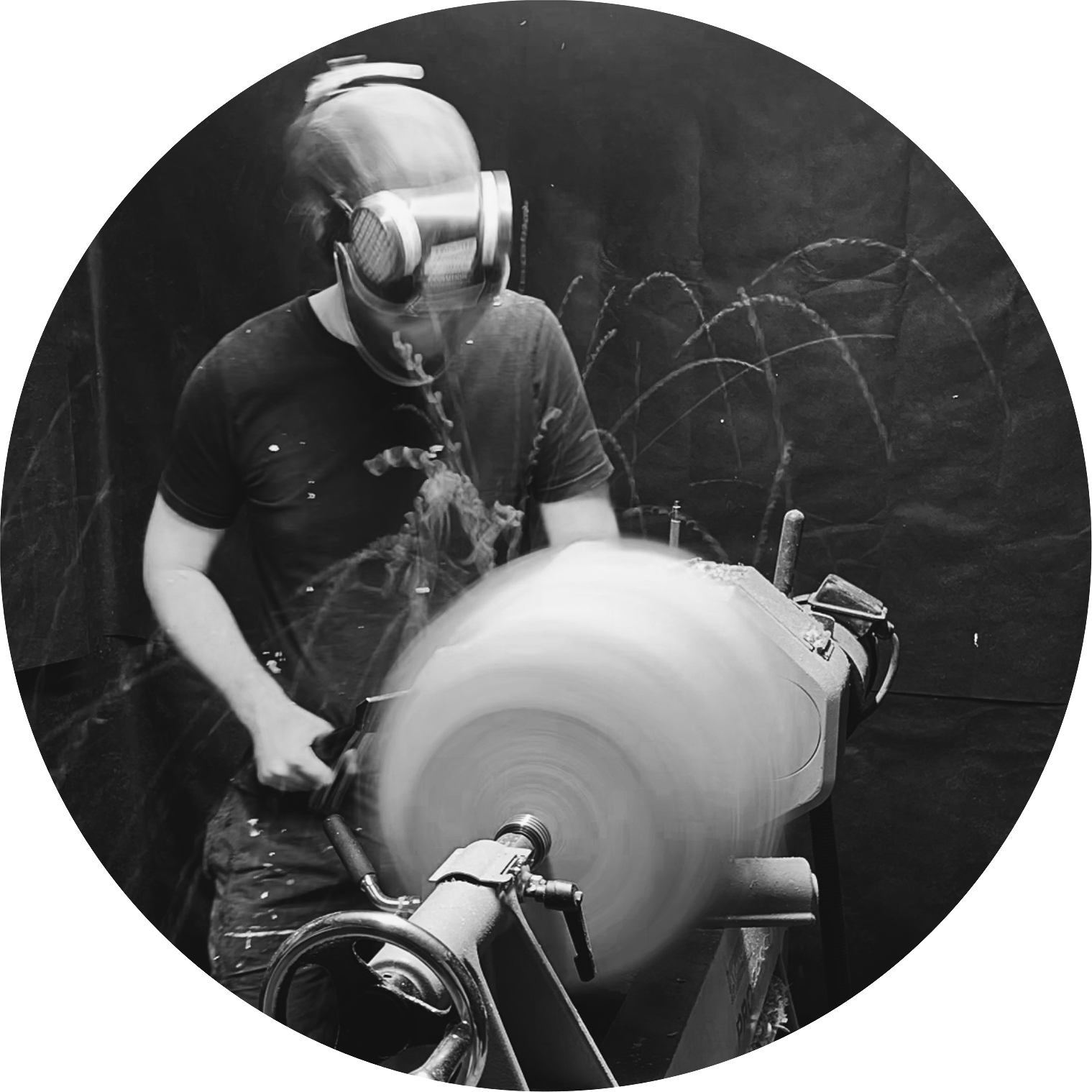
In 2024 I bought a wood-turning lathe and taught myself to use it via YouTube. I work exclusively with wood from trees that have fallen naturally or been felled by disease — nothing harvested for the sake of it. Every vessel is carved and manipulated by hand, tool marks and all. In an age of AI, that feels like a political act. Aggressively human. Simple, imperfect, and made.
Contact
For enquiries, commissions, or to discuss a piece, please email julian@julianemsley.com
Studio
Wimbledon Art Studios10 Riverside Road
London SW17 0BB